
Today, people around the world pause to commemorate what would have been Anne Frank’s 97th birthday — a reminder of a young girl whose voice has outlived the darkest chapter of the 20th century. Her diary, now translated into more than 75 languages, remains the most widely read personal journal in history. Few books have travelled so far or touched so many.
What does Anne Frank’s diary mean to you?
For me, it stands as a testament to resilience, to the quiet endurance of a Jewish family in hiding, and to the universal struggles of identity, conflict, and first love. Like many Dutch children, I first encountered Het Achterhuis (The Annexe) in primary school, around the age of ten or twelve. Even then, Anne’s words felt startlingly alive — intimate, observant, and wise beyond her years.
Years later, during a 2019 visit to Amsterdam with my husband, I found an English copy of the diary in an antiquarian bookshop. That same trip, we visited the Anne Frank House, the canal‑side building on the Prinsengracht where Anne, her family, and four others hid for more than two years. Walking through the narrow rooms of the Secret Annex, I felt the weight of her courage more deeply than ever.
Even under constant fear of discovery, Anne wrote with a clarity and hope that continue to astonish readers. Her famous line — “I still believe, in spite of everything, that people are truly good at heart.” — remains one of the most powerful declarations of faith in humanity ever written. She transformed a private diary into a universal symbol of resistance, compassion, and the necessity of remembering.
My encounters with Anne Frank’s legacy have stretched far beyond the Netherlands. In 2013, we visited the Anne Frank Monument in Aruba, a life‑size bronze statue in Oranjestad’s Wilhelmina Park. The figure of a young girl looking upward, wrists bound, is engraved with Anne’s words: “How wonderful it is that nobody need wait a single moment to improve the world!” The statue was unveiled exactly fifteen years ago today, in honour of her birthday — a Caribbean tribute to a European life that became global.
I’ve also walked through Berlin’s former Jewish Quarter in the Mitte district, where the New Synagogue rises in gold and stone, and the courtyards of Hackesche Höfe echo with layers of history. Each place adds another thread to the tapestry of remembrance.
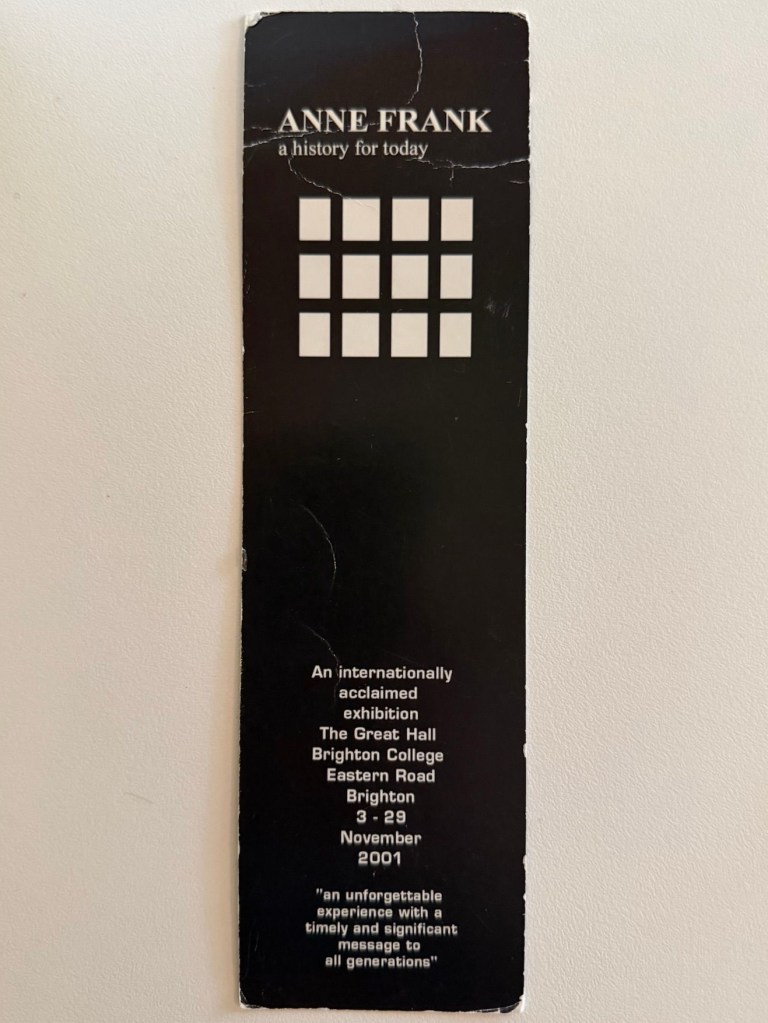
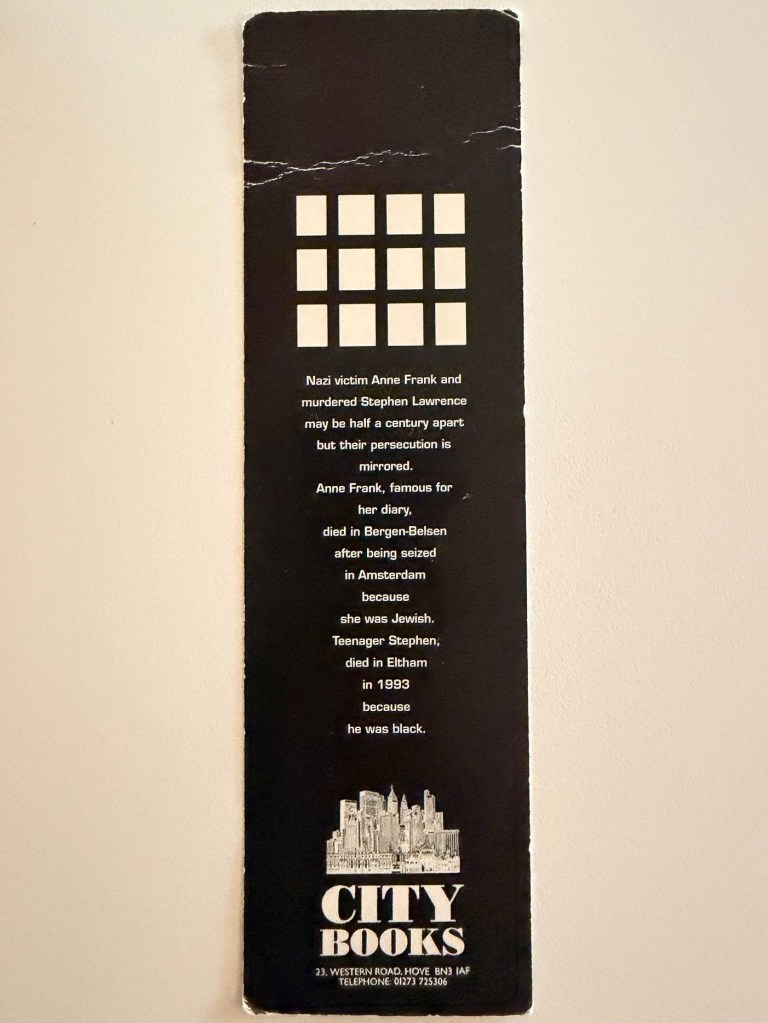
And then there was 2001 — the year I moved to Brighton. That November, Brighton College hosted the internationally acclaimed exhibition Anne Frank: A History for Today in the Great Hall on Eastern Road. The exhibition told the story of the Holocaust through Anne’s eyes, inviting young people to understand history not as distant tragedy but as lived experience. I still have the promotional bookmark I picked up there. It’s now twenty‑five years old. Time moves quickly, but memory has its own pace.
If you lived in Brighton then, did you visit the same exhibition? I’d love to hear your memories.